

By Sotiris M. Tzoumas
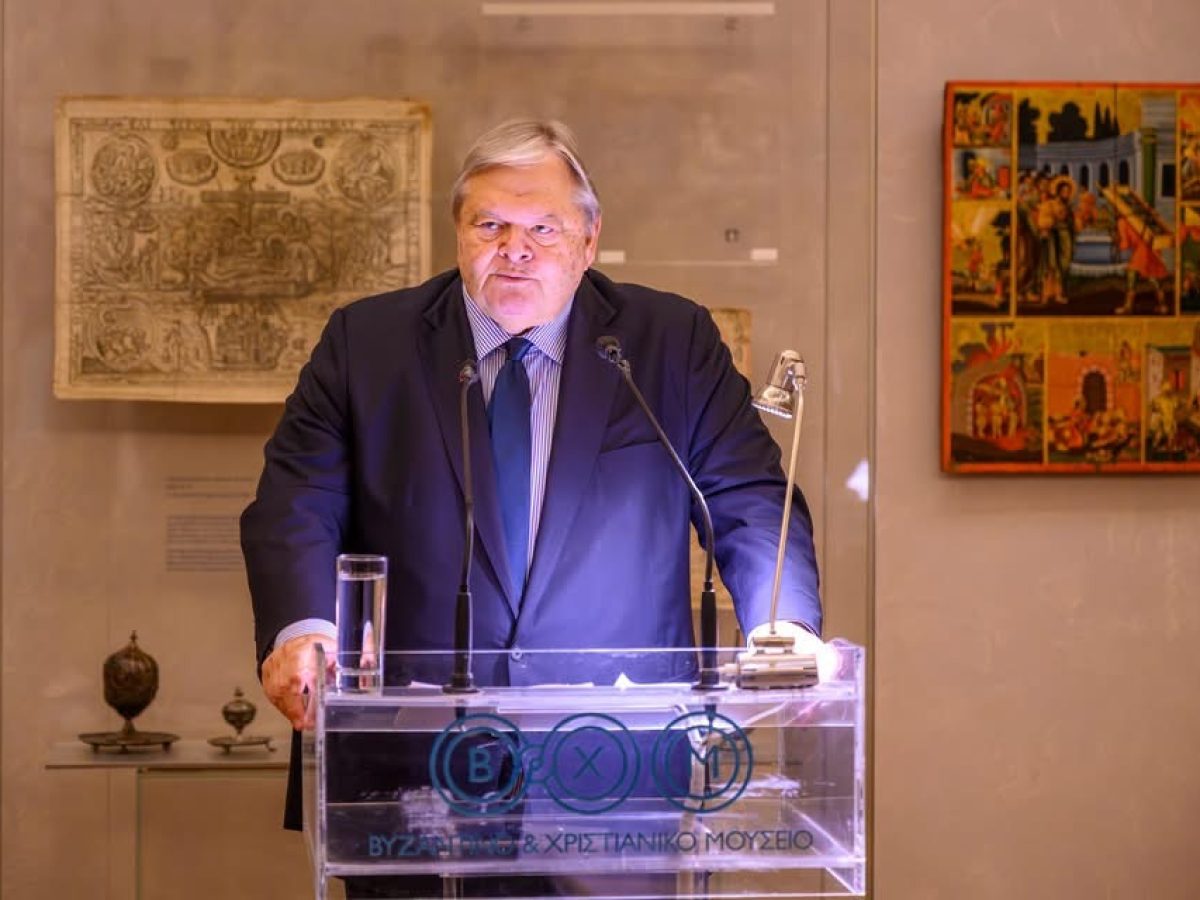
There are speakers who simply take the podium, and there are those who fill the room with thought. Evangelos Venizelos undoubtedly belongs to the latter. Listening to him, one delights in the breadth of his knowledge, the precision of his formulations, and his ability to connect fields we often regard as unrelated: law with history, politics with theology, international affairs with the responsibility of the Church.
This was the Venizelos whom the large audience that filled the multilevel premises of the Byzantine and Christian Museum in Athens on Monday, October 12, had the opportunity to hear. His lecture, entitled “The Ecumenical Patriarchate and the Primacy of the Word in a World Beset by Adversity,” was the second in a series of academic lectures organized by the Athens Representative Office of the Ecumenical Patriarchate, in collaboration with an academic committee of professors from the School of Theology of the National and Kapodistrian University of Athens.
The initiative began during the tenure of the Office’s energetic and hardworking Director, His Eminence Metropolitan Theodoretos of Laodicea.
It was a monumental address in terms of the density of its thought and the breadth of the issues it opened up. A contribution that gave substantive meaning to its title: what does it mean to have a voice in a world that suffers, is torn by conflict, and finds it increasingly difficult to listen?

The former Deputy Prime Minister and Minister of Foreign Affairs, Professor Emeritus of Constitutional Law at Aristotle University of Thessaloniki, demonstrated once again that his intellectual formation extends far beyond the boundaries of legal scholarship. A distinguished jurist, a thinker of philosophical depth, and a formidable orator, he also possesses remarkable theological insight. One could describe him as a passionate theological speaker in the fullest sense: someone who approaches theology as a living body of thought, capable of engaging with the dilemmas of our time.
Therein lies one of his distinctive gifts. He can move from the constitutional order to ecclesiology, and from human rights to ecotheology, while maintaining the thread of a demanding argument. His discourse is a torrent. It carries the listener through successive levels of reflection and reminds us how impoverished public debate becomes when reduced to slogans and easy certainties.
At the heart of the lecture was the ministry of the Ecumenical Patriarchate amid the trials of the contemporary world. References to Patriarch Bartholomew’s recent addresses in England on human rights and ecotheology brought to the fore the Church’s responsibility towards humanity and creation. The discussion of artificial intelligence, in turn, opened up a field in which technological progress calls for ever deeper ethical and spiritual reflection.

For the more the capabilities of machines increase, the more pressing the question of human responsibility becomes. Who decides? By what criteria? And what place does the human person retain in a world that is learning to measure almost everything, yet struggles to recognize the priceless value of each individual?
Professor Stavros Yangazoglou’s description of the address as a contribution grounded in “political realism” captures an essential aspect of it.
The Phanar, itself beset by adversity, is called upon to address a world likewise beset by adversity. Its spiritual presence is tested precisely where conditions are unfavourable, balances fragile, and human needs immense.
The primacy of the word thus acquires a deeper meaning: the responsibility to speak when silence abandons the human person, to engage in dialogue when suspicion prevails, and to defend dignity when it is subordinated to expediency.
The Church’s discourse fulfils its purpose when it becomes service, when it reaches the wounded person and offers direction and hope.
Metropolitan Theodoretos of Laodicea, Director of the Representative Office, delivered a warm introductory address, while Bishop Isidoros of Andida, Assistant Professor in the Department of Theology at the National and Kapodistrian University of Athens, offered the response with theological competence and maturity of thought.
The discussion that followed gave the audience an opportunity to take part in this reflection.
Among those present were Bishop Chrysostomos of Euripos, representing Archbishop Ieronymos; Metropolitans Joseph of Proikonnesos and Panteleimon of Veria; hierarchs of the Ecumenical Throne; Father Thomas Synodinos, Chief Priest of the Metropolitan Cathedral of Athens; Archons of the Great Church of Christ; members of Parliament; diplomats; and academics, including the Dean of the School of Theology, Emmanouil Karageorgoudis. The President of the Byzantine and Christian Museum, Mr Giorgos, was also present, among others. All these attendees underscored the significance of the gathering. Equally telling was the turnout of the public. There is still a thirst for substantive discourse, provided it finds the right platform.
Yet admiration also allows for a well-intentioned observation. Evangelos Venizelos needs to exercise greater economy of expression. The speed of his thinking, the density of his concepts, and the succession of connections he makes often exceed the ability of a diverse audience to keep pace. Not everyone possesses the same knowledge or the same familiarity with legal, philosophical, and theological terminology.
Listeners need time to understand, retain, and connect what they hear. They need a pause, a simple example, a brief recap.
Economy of expression is also a form of generosity towards those trying to follow. It reflects a concern that the wealth of knowledge should become a shared possession.
The great teacher knows how much more he can say; the mature teacher senses how much his audience can absorb at that particular moment.