
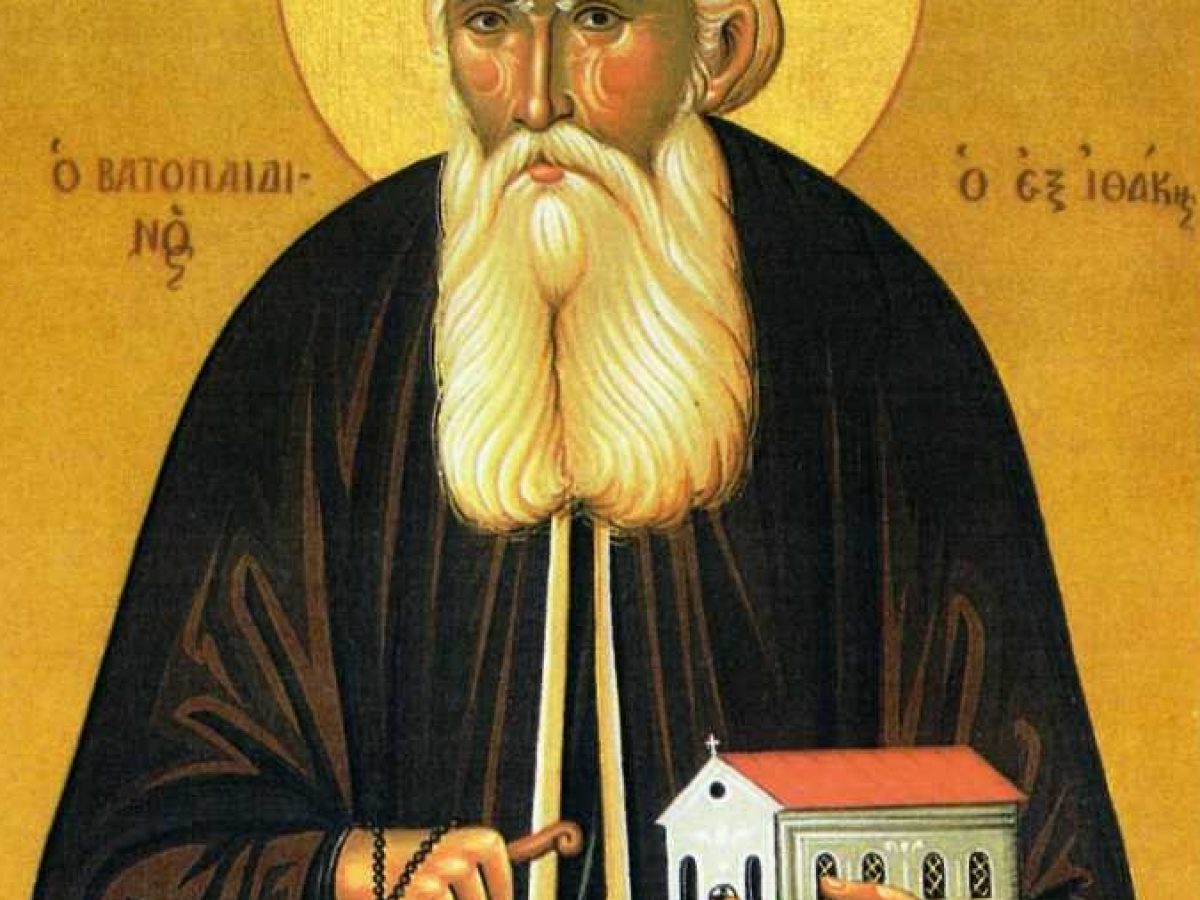
By all accounts it seems that blessed Joachim was a great hesychast**, because, whenever he found the opportunity, he would withdraw “into the wilderness” (Lk. 5:16), where he would pray “without ceasing” (1 Thes. 5:17). The Saint, as a laborer who readily embraced hardship, “kept the difficult ways” (Ps. 16:4 LXX) as a means of ascetic struggle, walking in the “narrow and difficult way” (see Matt. 7:14). Many Ithacans saw him treat his body with severity and, many times, without apparent reason, load himself up with rocks, the sole purpose being to undergo hardship and asceticism. In this way, in conjunction with grace, he acquired the divine charismata [i.e., gifts] of wonderworking and of victory over the evil one. As we shall see, the Saint was especially blessed with the gifts of clairvoyance** and prophecy. The pious Ithacans related innumerable accounts to us that clearly reveal these spiritual gifts of the Saint.
Our Holy Monastery considers it a special blessing that our venerable Elder, the monk Joseph, took on the writing of this book, because we know that a saint’s grace-filled inner world, filled with the riches of the sanctifying grace of the Holy Spirit, can only be understood by someone who has a “comparable life” and common life experiences. For exactly this reason, our venerable Elder, aware of the prerequisites for a person to undertake the writing of such a book, states in his epilogue that he “fears that perhaps what he has writ¬ten has slighted such a hero of God’s love.”
In addition, the reader of this book should bear in mind that our Elder had never received even a rudimentary educa¬tion. He attended only the first years of primary school. Consequently, this book has not been written according to literary rules of composition. In spite of these things, we are convinced that with his more than fifty years of monastic experience on the Holy Mountain, and especially with his many years as a disciple at the feet of his elder, Joseph the Hesychast, he has written about and commented on the amazing life of blessed Joachim of Vatopaidi, from Ithaki, in a completely patristic manner.
With all these things in mind, we feel the pressing need, as we proceed with this second edition, to make this Vatopaidi saint all the more known as a contemporary manifestation of the Holy Spirit in today’s materialistically minded world, especially following his official enrollment by the Mother Church into the catalog of saints of the Orthodox Church. Thus, once again, we have clear proof that “Jesus Christ is the same yesterday, today, and forever” (Heb. 13:8).
We owe a great debt of gratitude to the Very Reverend Metropolitan of Levkas and Ithaki, Bishop Nikiphoros who demonstrated his concern for the Saint by making it possible for his relics to be exhumed in 1992. Consequently, our Church has been enriched by the presence of his divinely blessed relics.
We also owe thanks to all those who assisted in the gathering of material about the life and the miracles of the Saint, as well as to those who helped with the unearthing of his grace-flowing relics, especially to the reverend Father Theodosios Dendrinos and to the pious teacher, Mr. Konstantinos Kanellos.
The recent official enrollment of Saint Joachim into the Calendar of Saints of the Orthodox Church by the august Ecumenical Patriarchate — which we filially thank for its part in bringing us this great joy — has also contributed to the furthering of the awareness of his supernatural struggles.
We humbly pray that this second edition of Saint Joachim’s life will contribute to the rekindling of the devout readers’ yearning for God.
The Abbot of the Holy Great
Monastery of Vatopaidi
Arcimandrite Ephraim
to be continued…