
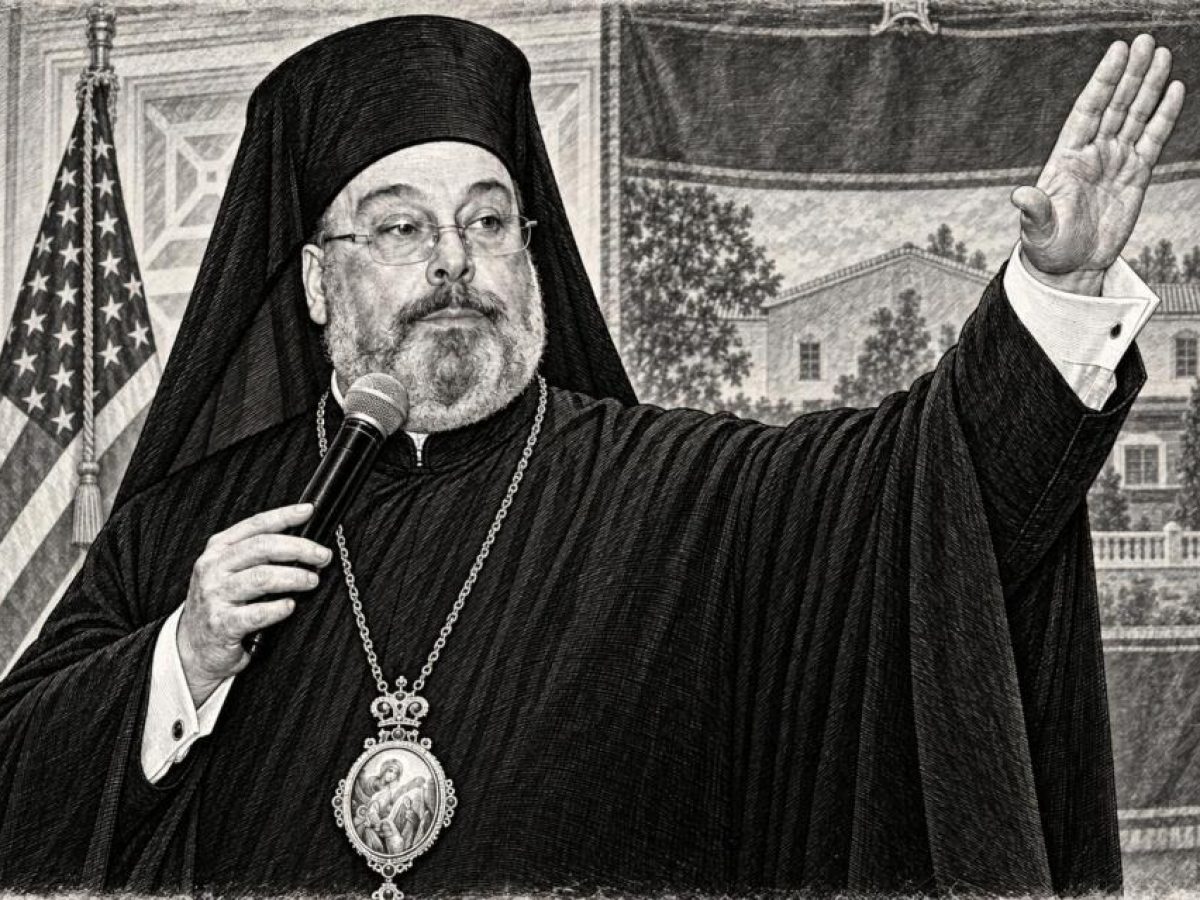

Archbishop Elpidophoros imposed his will and the Eparchial Synod complied — The case of Metropolitan Evangelos of Sardis exposes the entire leadership of the Archdiocese of America. The Patriarch, too, will stand exposed unless he rejects and returns the triprosopon.
.
By Sotirios M. Tzoumas
There are moments when ecclesiastical institutions are judged not by their grand declarations, but by the way they treat a brother in distress. It is precisely at such moments that synodality, pastoral sensitivity, episcopal conscience and, ultimately, the very humanity of the shepherds are put to the test.
During the meeting of the Eparchial Synod of the Holy Archdiocese of America, convened to draw up the triprosopon—the list of three candidates—for the Metropolis of New Jersey, Archbishop Elpidophoros and the hierarchs who comprise the Eparchial Synod were presented with a historic opportunity: to heal a deep and long-standing wound, to restore a sense of justice, and to demonstrate that the Church is not a place where people are destroyed, but a place of repentance, reconciliation and restoration.
They failed to do so.
The results are revealing:
- Bishop Athenagoras of Nazianzos received five votes.
- Archimandrite Bartholomew Mercado received five votes.
- Bishop Antonios of Synada received five votes.
- Metropolitan Evangelos of Sardis received only three votes. We have learned who voted for him, but for the time being we shall not disclose their names. Their time will come.
These figures do not merely record an electoral outcome. They reveal a grave moral and ecclesiastical failure.
With the exception of the three hierarchs who honored him with their vote, the remaining bishops of America turned their backs on a former fellow bishop and brother who was removed from his Metropolis without the faithful ever being presented with a clear, comprehensive and publicly disclosed indictment, and without any prior procedure capable of convincing the Church that his own account—his defense—had truly been heard.
They bundled him away and declared him deposed. It was the very height of vindictiveness and malice.
This certainly is not synodality.
It is submission to a predetermined course of action, imposed “by judgments known only to the Lord.”
The Synod Is Not a Ratifying Mechanism
The Metropolitans of the Archdiocese of America were not summoned to that meeting to serve as extras in someone else’s production or merely to rubber-stamp the Archbishop’s wishes.
They were not consecrated to calculate balances of power, protect their positions, or consider which vote would be most pleasing to the ecclesiastical establishment.
They were consecrated to bear witness to the truth. They took sacred vows of honor.
They were consecrated to defend justice.
To stand tall when one of their brothers is wronged.
To say “no” when personal will and egotism seek to replace synodal judgment.
If a hierarch cannot do these things even behind the closed doors of a Synod, when exactly will he dare to do them? And what value, then, does his synodal vote possess?
The Church does not need silent majorities. It needs free bishops endowed with conscience, boldness and a sense of responsibility before God and history.
Regrettably, in this case, the majority of the hierarchs proved unequal to the occasion. Instead of standing united in support of the restoration of their suffering brother, Evangelos, they became a compliant mechanism serving the will of Archbishop Elpidophoros.
Instead of raising their voices, they remained silent.
Instead of healing the wound, they prolonged it.
Instead of serving synodality, they allowed the Synod to become an arena in which one man’s personal strategy was imposed.
The burden of responsibility no longer rests solely with the Archbishop. It is shared by all those who knew what was happening, who could have resisted, and who ultimately chose not to do so.
They, too, bear responsibility.
The Role of Archbishop Elpidophoros
According to information published by the distinguished journalist Theodore Kalmoukos in the historic newspaper The National Herald, Archbishop Elpidophoros insisted that Metropolitan Evangelos of Sardis should not be included in the triprosopon, citing supposed “outstanding issues.”
He is also reported to have sent a letter to Ecumenical Patriarch Bartholomew explaining why, in his view, Evangelos should not return to New Jersey.
The same reports indicate that, during the preceding days, the Archbishop contacted hierarchs of the Eparchial Synod and sought their support for a specific candidacy.
If these reports are accurate, an inescapable question arises:
How can a free and uninfluenced synodal process take place when the presiding hierarch has already mobilized behind the scenes to shape its outcome? What inspiration of the Holy Spirit can one possibly speak of under such circumstances? Through their own conduct, they make a mockery of themselves and diminish the dignity of a sacred procedure.
The Synod is not the Archbishop’s electoral campaign headquarters. Metropolitans are not votes to be managed. An episcopal conscience must never be surrendered to pressure, promises, fear or personal dependency.
Archbishop Elpidophoros had an opportunity to make a courageous new beginning. He could have demonstrated that an ecclesiastical leader does not diminish himself by correcting an injustice; he becomes greater. He is not defeated when he heals a wound; he is vindicated. He does not lose authority when he rises above a personal conflict; he acquires spiritual stature.
We wrote precisely this and attempted to make him understand where his own true interest lay. Yet his ego appears to be greater than his stature.
He could have said: “Enough division. The Church needs peace, unity and restoration.”
He did not.
Everything indicates that he chose to continue the exclusion. He demonstrated that he did not wish the wound to close, but preferred it to remain open until the outcome he had pursued from the beginning became firmly established.
Once again, he involved the Patriarch in his plans. He used the Patriarch’s name to persuade wavering Metropolitans to do what he demanded of them.
But this is not strength. It is an inability to rise above personal passion.
It is not leadership. It is governance through control.
It is not pastoral care. It is the management of human beings according to whether they are useful, convenient or obedient—whether, in other words, they are entirely under one’s control.
History is filled with examples of such conduct. They have never ended well for the schemer.
Where Were Evangelos’ Brother Bishops? Where Were the Other Nine?
This severe criticism cannot be confined to Archbishop Elpidophoros. The other Metropolitans are not beings without a will of their own. They possess personality, a vote and full episcopal responsibility. We had believed that they also possessed a conscience.
They knew the history of the case.
They knew the circumstances under which Evangelos was removed from New Jersey.
They knew that his return would have constituted an act of healing and reconciliation.
They knew that the prevailing climate at the Phanar was said to be favorable to his restoration.
And yet most of them chose to align themselves with the powerful.
Where, then, was their brotherly love?
Where was their episcopal courage?
Where was their empathy for a hierarch who has carried the burden of an exceptionally painful ordeal for years?
A bishop cannot preach love, forgiveness and brotherhood, yet hide behind political calculations and expediencies when the time comes to practice what he teaches.
He cannot preach about the Good Samaritan and then pass by his wounded brother for fear of displeasing whoever happens to hold power.
He cannot demand sacrifice, courage and confession of faith from his flock when he himself lacks the courage to defend justice within the Synod.
Those who surrendered their judgment and their vote to the will of the Archbishop cannot plead ignorance or neutrality. Through their conduct, they became parties to the injustice. They allowed the Eparchial Synod to be used not as an assembly of free and equal hierarchs, but as a mechanism for producing a predetermined result.
They became pawns in a game that does not serve the Church, but rather personal ambitions and balances of power.
And that was profoundly unjust.
Tragic and Fateful Shepherds
Yes, these are harsh words. But the responsibility they bear is harsher still.
They are tragic because they appeared incapable of overcoming their fear and dependency.
They are fateful because, through their vote, they did not merely pass judgment on one man; they damaged the standing of synodality itself and deepened the Greek-American community’s mistrust of the ecclesiastical administration.
They proved to be shepherds devoid of empathy in practice because they did not feel—or did not wish to feel—the burden that one of their brothers has carried for so many years.
They are hierarchs burdened with a grave responsibility of conscience because, when called upon to choose between healing an injustice and serving an archiepiscopal desire, they chose the latter.
This day does not mark a victory for Archbishop Elpidophoros.
It marks the defeat of the Eparchial Synod and a blow to the entire Archdiocese of America. It is also a resounding rebuke to those within the Phanar who allowed this situation to unfold.
An Archbishop who requires compliant hierarchs to confirm his authority is not truly powerful. And a Synod that does not dare oppose the will and ego of its presiding hierarch does not function as a Synod; it functions as a rubber-stamp council.
Elpidophoros does not possess some superior ecclesiastical standing over the other hierarchs. He is their equal.
One can only imagine what he might attempt were he ever to become Patriarch.
May it never be so.
The Patriarch’s Twofold Responsibility—and His Duty to Return the
Triprosopon
According to reports that were made public and never denied, Ecumenical Patriarch Bartholomew stated before the Holy and Sacred Synod that, should Metropolitan Evangelos of Sardis be included in the triprosopon submitted by the Eparchial Synod, he would—upon the Patriarch’s own proposal—be elected Metropolitan of New Jersey.
Once this position became known, what followed appears to have been an organized campaign to undermine and exclude Metropolitan Evangelos. People familiar with both the individuals and the circumstances had warned me of this, but I did not wish to believe them. For that reason, in my previous article I attempted to play down these reports and leave open the possibility that Archbishop Elpidophoros might demonstrate integrity, courage and magnanimity.
During the meeting of the Eparchial Synod, however, the truth became apparent. According to the available information, the Archbishop himself acknowledged that he had worked against Evangelos’ return to New Jersey.
The objective was clear: Evangelos had to be prevented from entering the triprosopon because Elpidophoros knew that, had he been included, his election by the Holy and Sacred Synod of the Ecumenical Patriarchate would have been highly probable—perhaps even certain.
Why, however, such persistence?
Why such intense mobilization?
Why would an Archbishop campaign so relentlessly to exclude an experienced and tested hierarch from the Metropolis that he served for years and, in effect, built from the ground up?
The reasonable answer may be found in the plans long attributed to the leadership of the Archdiocese: the weakening of the Metropolis of New Jersey, the removal of significant and financially strong parishes from its jurisdiction, and their direct subordination to the Archdiocese.
Evangelos’ return would have presented an obstacle to such a plan. A Metropolitan with intimate knowledge of the people, the communities and the real problems of the region would not readily consent to the dismemberment of his ecclesiastical province.
If, therefore, Evangelos’ exclusion is indeed connected with the advancement of such an administrative restructuring, then we are not dealing merely with a personal confrontation. We are facing a serious institutional maneuver: first, the individual capable of resisting is excluded; then the path is cleared for plans that would otherwise encounter strong opposition.
It is precisely here that the Ecumenical Patriarch’s twofold responsibility begins.
First, he bears responsibility because he allowed this deep wound within the Archdiocese of America—the most valuable and powerful Eparchy of the Ecumenical Throne—to be opened and left to fester for so many years.
He will bear an even greater responsibility if, now fully aware of what has occurred, he permits the completion of a process whose outcome appears to have been shaped by interventions behind the scenes, pressure and the deliberate exclusion of a particular person.
It is not enough to say that Evangelos would have been elected had he been included in the triprosopon. The essential question is what the Patriarch will do now that Evangelos has been excluded precisely in order to prevent his election.
Patriarch Bartholomew possesses both the institutional authority and the historical precedent necessary to intervene.
During the first process for the election of the Metropolitan of Chicago, the Eparchial Synod did not include the then Metropolitan Nikitas of the Dardanelles—now Archbishop Nikitas of Thyateira and Great Britain—in the triprosopon. The Phanar returned the list and ordered the process to be repeated.
That renewed process resulted in the election of the present Metropolitan Nathanael of Chicago. As subsequent developments demonstrated, that intervention benefited both the Metropolis and the Ecumenical Patriarchate. The only person who appears uncomfortable with Nathanael’s presence is Archbishop Elpidophoros.
Why, then, should the same not happen now?
Why should a triprosopon that raises such serious questions regarding the manner in which it was constituted be treated as inviolable?
Why should a process that deepens division instead of healing it be rewarded?
And why should the Phanar accept that its publicly expressed will can be circumvented through the pre-emptive and provocative exclusion of one individual?
Returning the triprosopon would not constitute an act of vengeance or personal favoritism toward Evangelos. It would be an act of institutional self-protection on the part of the Ecumenical Patriarchate itself.
It would send a clear message that synodal procedures must never be transformed into instruments serving personal designs; that the Mother Church will not tolerate manipulation; and that justice will not be sacrificed upon the altar of temporary balances and expediencies.
The Patriarch is now called upon to prove that his paternal concern is not exhausted in speeches and promises.
He is called upon to heal the wound that he allowed to be opened, even if he did not originally intend it.
He must return the triprosopon.
He must order the process to be repeated.
He must give the hierarchs of America one final opportunity to vote freely and to rise to the dignity and responsibility of their episcopal office.
Leadership is not judged solely by the decisions it makes. It is judged above all by the courage it demonstrates in correcting decisions that prove unjust.
History Will Be Relentless Toward Them All
History will not record only who was ultimately elected Metropolitan of New Jersey. It will also record the manner in which the triprosoponwas assembled.
It will record who applied pressure, who orchestrated events, who yielded and who remained silent.
It will remember those who abandoned a brother in distress in order to avoid placing their own positions at risk, and those who exchanged their episcopal freedom for the favor of those in power.
Above all, history will record that, when the leadership of the Archdiocese of America was given an opportunity to heal a wound, it chose to keep it open.
Instead of restoring peace, it invested in division.
Instead of administering justice, it protected personal plans and expediencies.
Instead of acting as the Church, it operated as a cold mechanism for the management of power.
Metropolitan Evangelos of Sardis may not have been restored today by those who possessed the institutional authority to do so. He has, however, been restored in the conscience of a substantial part of the Greek-American community and the body of the faithful.
That restoration is deeper than a title and more powerful than a vote because it cannot be imposed through synodal decisions, nor can it be revoked through administrative maneuvers.
Those who failed to stand beside him must understand that their silence does not absolve them. It makes them jointly responsible.
He can decide whether history will remember him as the Patriarch who healed a deep wound, or as the one who, although he possessed the power to close it, allowed it to become infected.
There is no longer room for diplomatic silence, balancing acts or evasions.
Now is the time for a decision.
The Church is not asking for a favor on behalf of Evangelos. It is demanding justice.
The Greek-American community is not asking for yet another settlement negotiated behind closed doors. It is demanding transparency, truth, respect for its institutions, and respect for the people it has loved—people who labored for its welfare.
History now waits to record who stood upright and who knelt before power.
Those who failed to stand beside Evangelos will one day be called to answer not only before ecclesiastical history, but first and foremost before their own episcopal conscience.
If, of course, they still possess one—and are still capable of hearing its voice.
Let each man assume his responsibility.
And let everyone understand this: human beings may forget, titles may pass away, and thrones may change occupants—but injustice endures.
Sooner or later, it returns to demand an account from those who committed it, those who concealed it, and those who possessed the power to prevent it but lacked the courage to act.